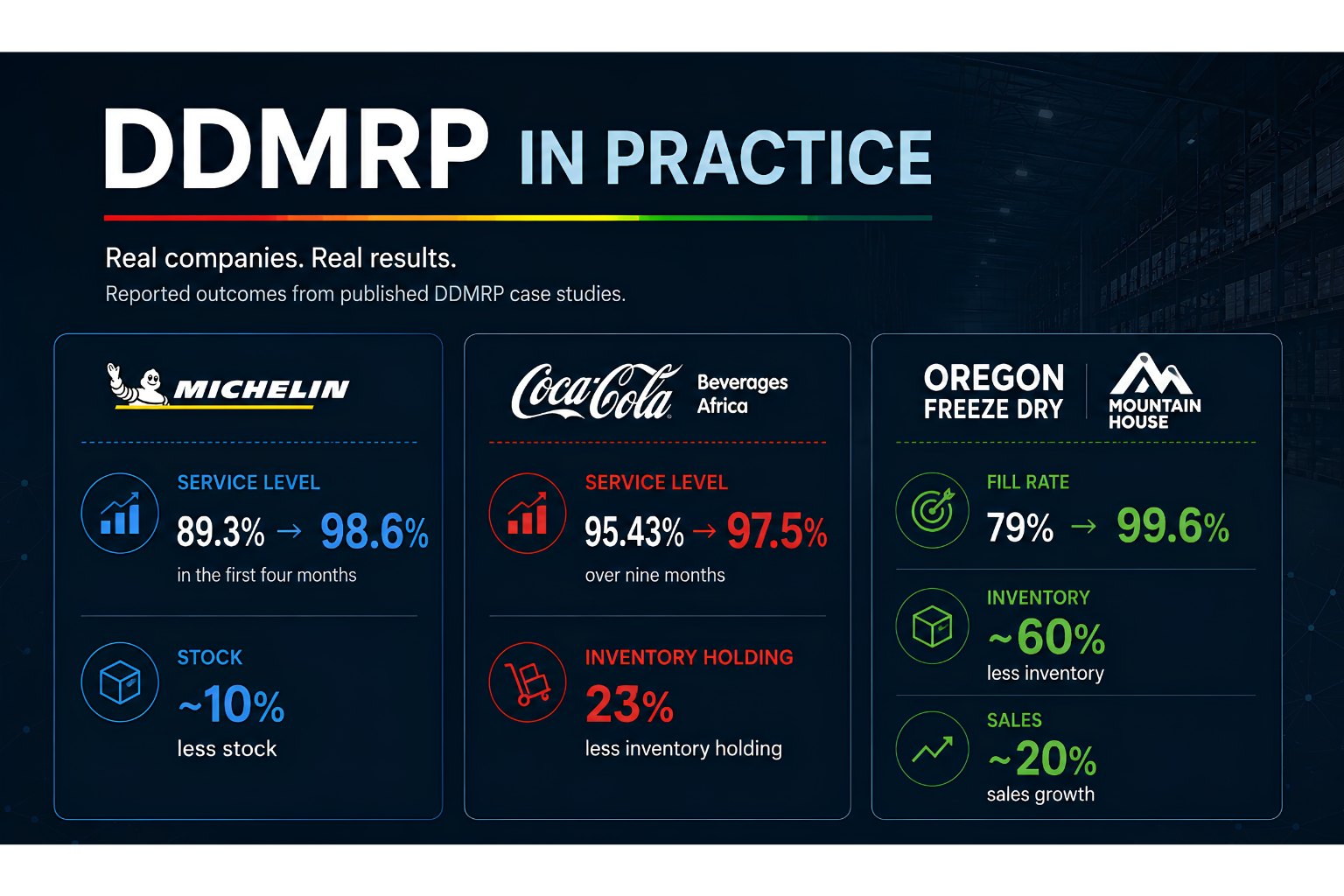
What if your business could hold 23% less inventory while improving customer service?
Or increase its ability to fulfil customer orders from 79% to 99.6%, while cutting inventory by around 60%?
Both have been reported in real DDMRP implementations.
Coca-Cola Beverages Africa reported the first during a nine-month implementation in South Africa. Oregon Freeze Dry, the manufacturer behind Mountain House freeze-dried foods, reported the second, alongside sales growth of around 20%.
Michelin has reported similar improvements. Within four months of an early DDMRP pilot, service levels increased from 89.3% to 98.6%, while stock fell by approximately 10%.
For a business with millions tied up in inventory, numbers like these are difficult to ignore.
The results are impressive. So why aren't companies simply doing it?
The answer lies partly in how inventory is planned, where it sits in the supply chain, and what happens when actual demand differs from the forecast.
The methodology behind this is called Demand Driven Material Requirements Planning, or DDMRP.
So, what exactly is DDMRP?
DDMRP is a supply-chain planning methodology developed by Carol Ptak and Chad Smith and formally introduced in Orlicky's Material Requirements Planning in 2011.
It draws on established approaches including MRP, Lean and Theory of Constraints, but changes how materials are planned and replenished.
Traditional planning relies heavily on forecasts to calculate what will be needed across the supply chain. DDMRP still uses forecasts, but gives actual demand a much bigger role in short-term decisions. Inventory is positioned at strategic points and replenished according to what is actually being consumed.
Forecasts help the business prepare for the future. Actual demand plays a much greater role in deciding what it does today.
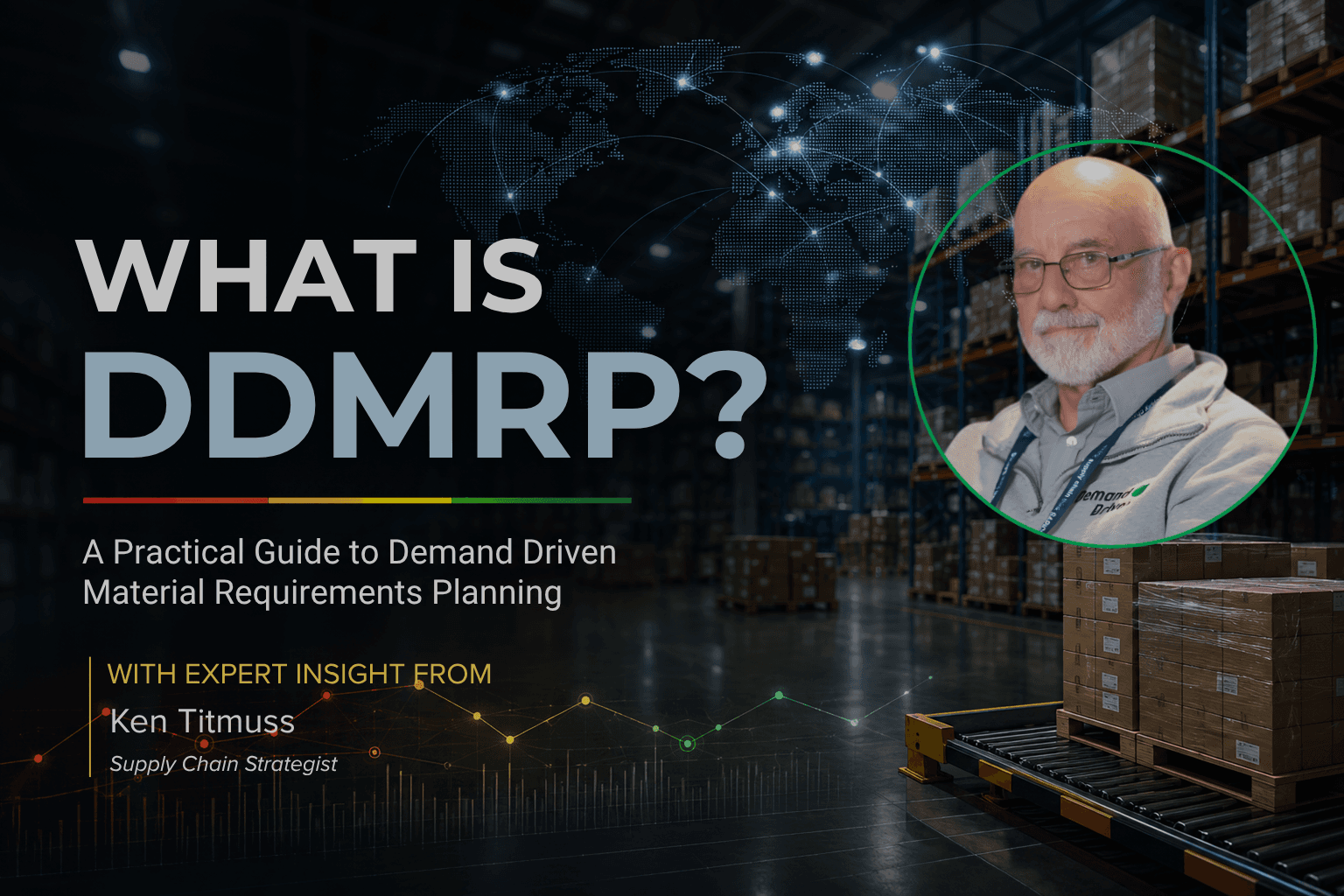
To understand how that works in practice, we spoke to supply-chain strategist Ken Titmuss, a long-standing practitioner and educator in demand-driven methodologies.
For Titmuss, understanding DDMRP starts with the problem it is trying to solve: what happens to a supply chain when the forecast is wrong?
The problem with trying to predict everything
Every business needs forecasts. You need some idea of what customers might buy next month to plan production, and a longer-term view to make decisions about factories, suppliers, equipment and investment.
The problem comes when an uncertain forecast gets translated into thousands of precise operational decisions.
Imagine a company forecasts that it will sell 10,000 units of a product three months from now. That creates requirements for finished products, components and raw materials, with purchasing and production schedules built around them before the customer actually buys anything.
Then reality arrives. Customers buy 8,000. Or 12,000. Or they buy 10,000, but the mix between products is completely different.
A supplier is late. A promotion performs unexpectedly well. A customer postpones an order. A new product takes demand away from an old one.
None of this would matter quite as much if the forecast were only a forecast. The problem is that the business has already acted on it. Materials may have been ordered, production scheduled and inventory built around demand that hasn't happened yet.
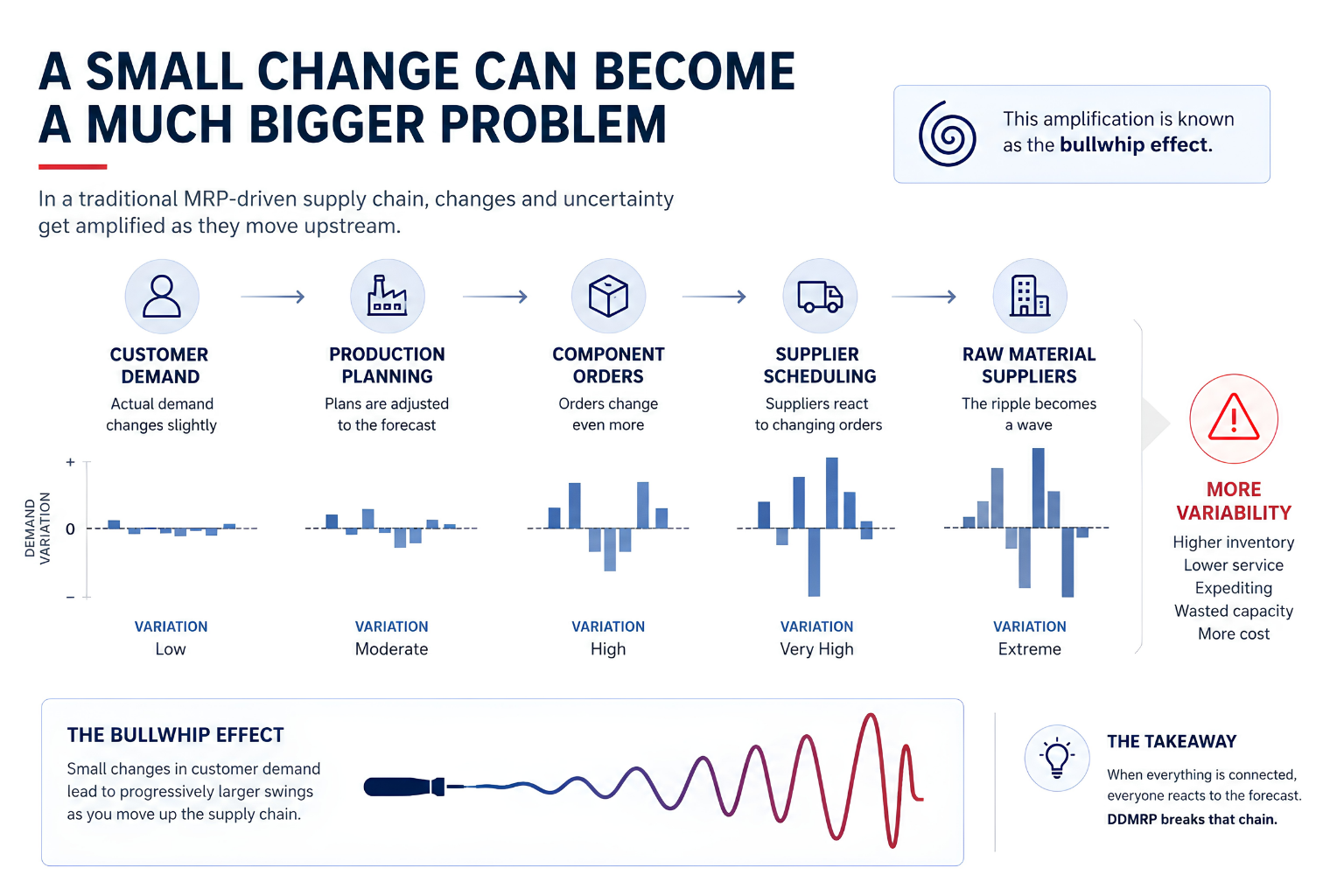
When the forecast changes, those plans change too. New orders are raised, existing ones are moved, production priorities shift and suppliers are asked to respond. A relatively small change in customer demand can end up creating much larger changes further back through the supply chain.
The forecast wasn't necessarily bad. The future simply didn't cooperate.
Titmuss points to three problems with forecasting: every forecast contains some error, accuracy declines further into the future, and predicting demand becomes harder at increasingly detailed levels.
The decisions created by that forecast then travel through purchasing, production, suppliers and inventory, with each part of the supply chain reacting to what it believes will be needed.
This is the problem DDMRP is designed to deal with.
How can you have too much inventory and still run out of stock?
This is where the problem becomes financially interesting. Businesses often respond to uncertainty by protecting themselves with inventory. Yet many end up with warehouses full of stock while still being unable to supply certain customer orders.
Titmuss describes this as bimodal inventory: too much of the wrong stuff and too little of the right stuff.
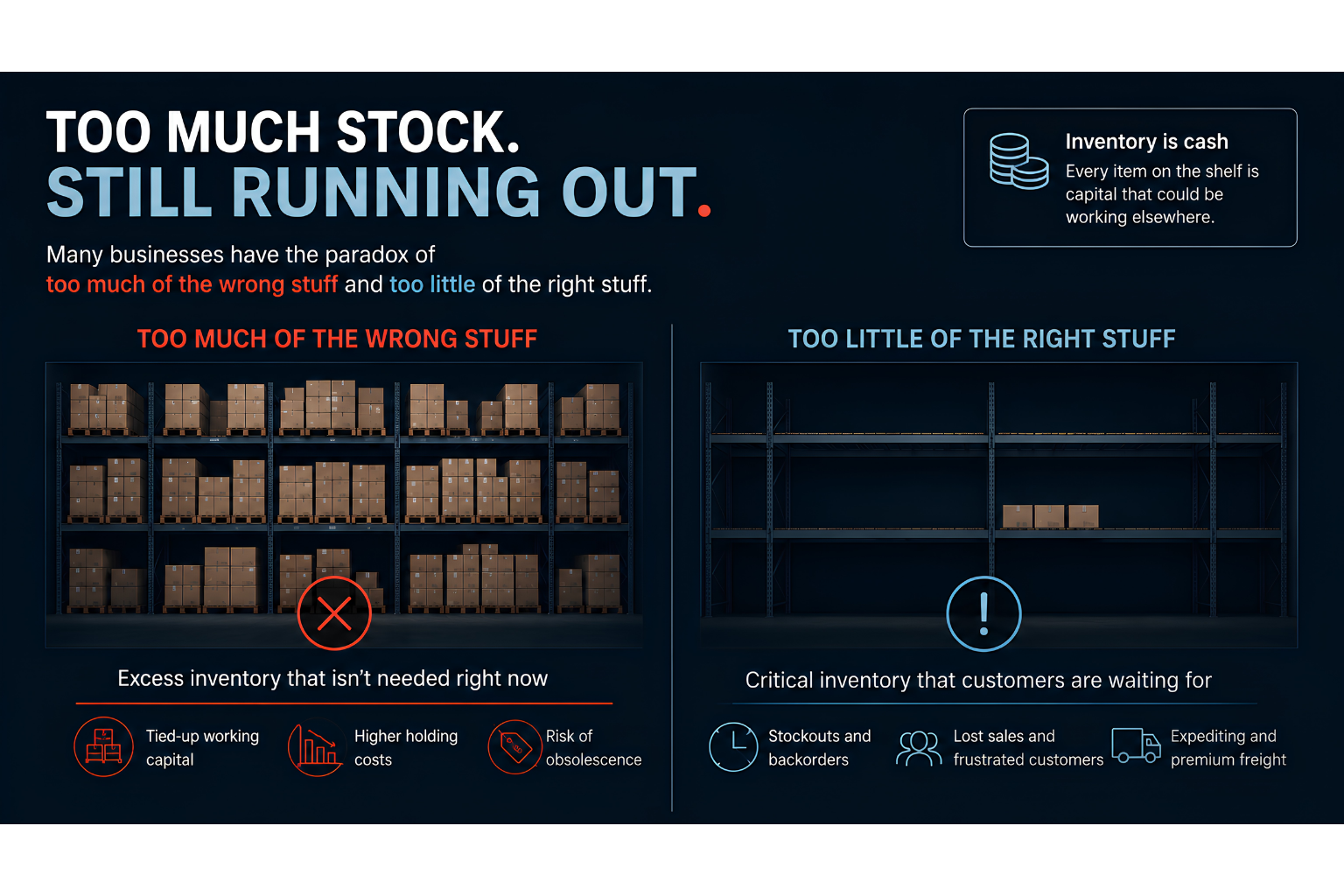
The objective of DDMRP isn't simply to reduce inventory. It's to right-size it and put it where it is actually needed.
Titmuss compares a warehouse to a company's bank vault. Every pallet, component and finished product represents cash the company has converted into inventory.
Reducing unnecessary stock can release working capital. Cut it in the wrong place, however, and the result can be shortages, expediting, delayed orders and lost sales.
The challenge is deciding where inventory should sit and how much is actually needed.
Where should we put our inventory so that every euro, pound or dollar tied up in stock is doing something useful?
Instead of protecting everything, protect the right places
Imagine a product has to pass through five stages before reaching the customer. If every stage depends on the one before it, delays and changes can travel through the entire chain.
DDMRP looks for strategic points where that dependency can be broken by holding an appropriate amount of inventory. This is called decoupling.
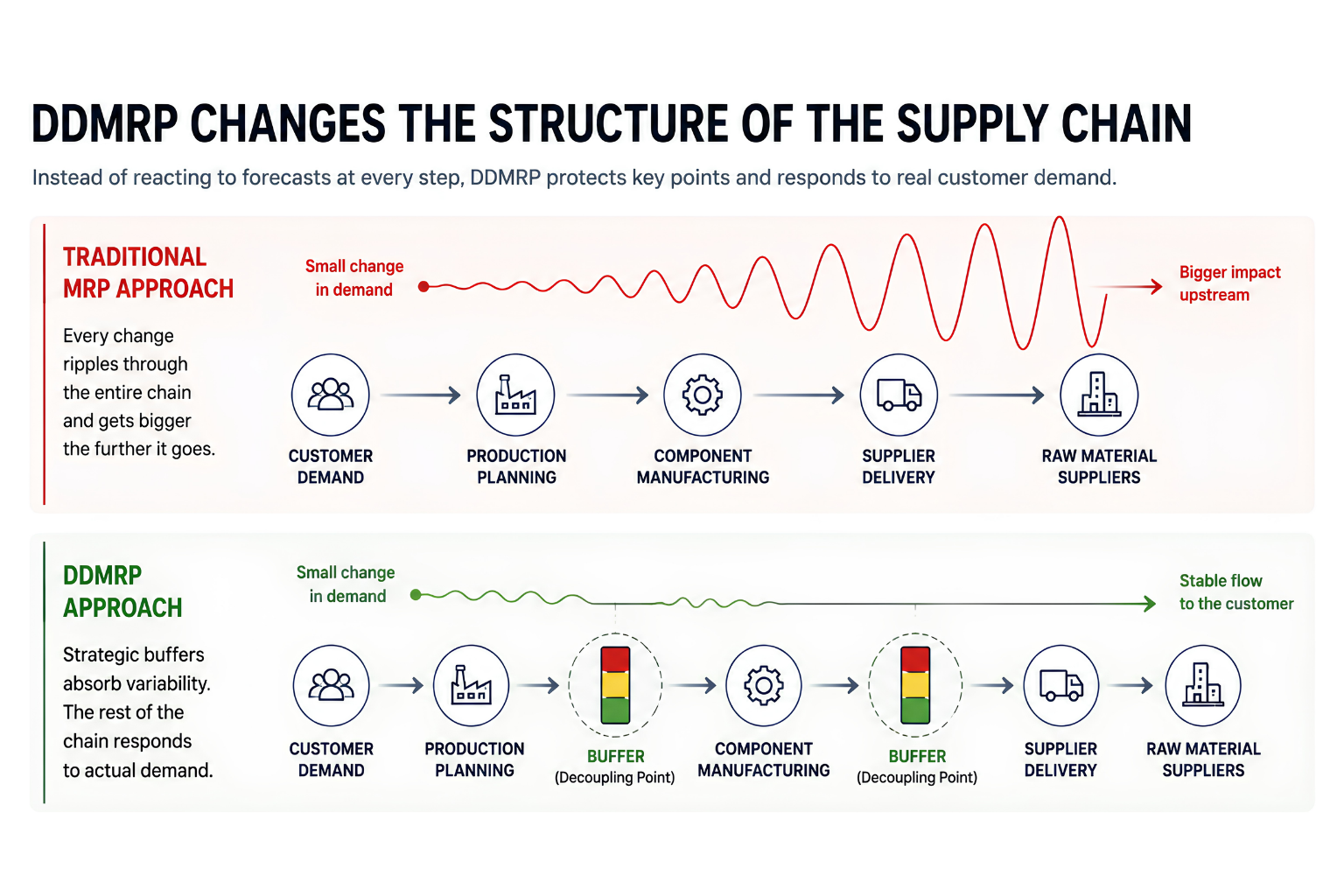
Titmuss describes these points as shock absorbers. They prevent every change in one part of the supply chain from immediately affecting everything else.
Where those points sit matters. A component shared by ten finished products, for example, may be more useful to hold than large quantities of all ten products.
Keeping the common component available gives the business options. When customer demand becomes clearer, it can be turned into the product customers actually want rather than making ten separate bets months in advance.
The inventory isn't static either
The inventory held at these strategic points isn't fixed. DDMRP uses buffers that adjust as demand, lead times and other conditions change.
These are commonly represented as red, yellow and green zones, helping planners see where inventory is healthy and where flow may be at risk.
Titmuss describes many planning teams as “drowning in data, but starved of relevant information.” The point is to make it easier to see what actually needs attention.
Does DDMRP mean forecasts don't matter anymore?
No. Forecasts still matter. They help businesses make longer-term decisions about capacity, suppliers, seasonal demand and investment.
What changes with DDMRP is the role the forecast plays in day-to-day planning. Rather than using it to trigger every purchasing and production decision in advance, actual consumption has a much greater influence on replenishment.
If customers consume inventory, the system responds. If they don't, the business isn't automatically producing simply because an earlier forecast said they would.
That's the distinction: forecasts help plan what may happen; actual demand helps determine what needs to happen now.
What does this look like when companies actually try it?
The reported results vary between implementations, but several documented examples show why DDMRP has attracted attention.
Michelin reported service levels increasing from 89.3% to 98.6% during the first four months of an early pilot, while stock fell by approximately 10%. The company subsequently expanded demand-driven planning more widely through its operations.
At Coca-Cola Beverages Africa, a documented South African implementation reported service levels increasing from 95.43% to 97.5% over nine months, alongside a 23% reduction in annual inventory holding.
Oregon Freeze Dry, the manufacturer behind Mountain House, reported customer fill rates increasing from 79% to 99.6%, while inventory fell by around 60% and sales increased by approximately 20%.
The figures are striking, but they shouldn't be treated as benchmarks for what another company will achieve. What makes these examples interesting is that improvements in inventory were reported alongside improvements in customer service.
That is an important part of the DDMRP argument. The aim isn't simply to carry less stock. It's to make the inventory you do carry work harder.
Michelin and Coca-Cola aren't isolated examples
DDMRP has been documented across very different industries. Companies including Unilever, JELD-WEN, PPG, Mettler Toledo, Assa Abloy, Haier Europe and Allergan have all used demand-driven approaches within their operations.
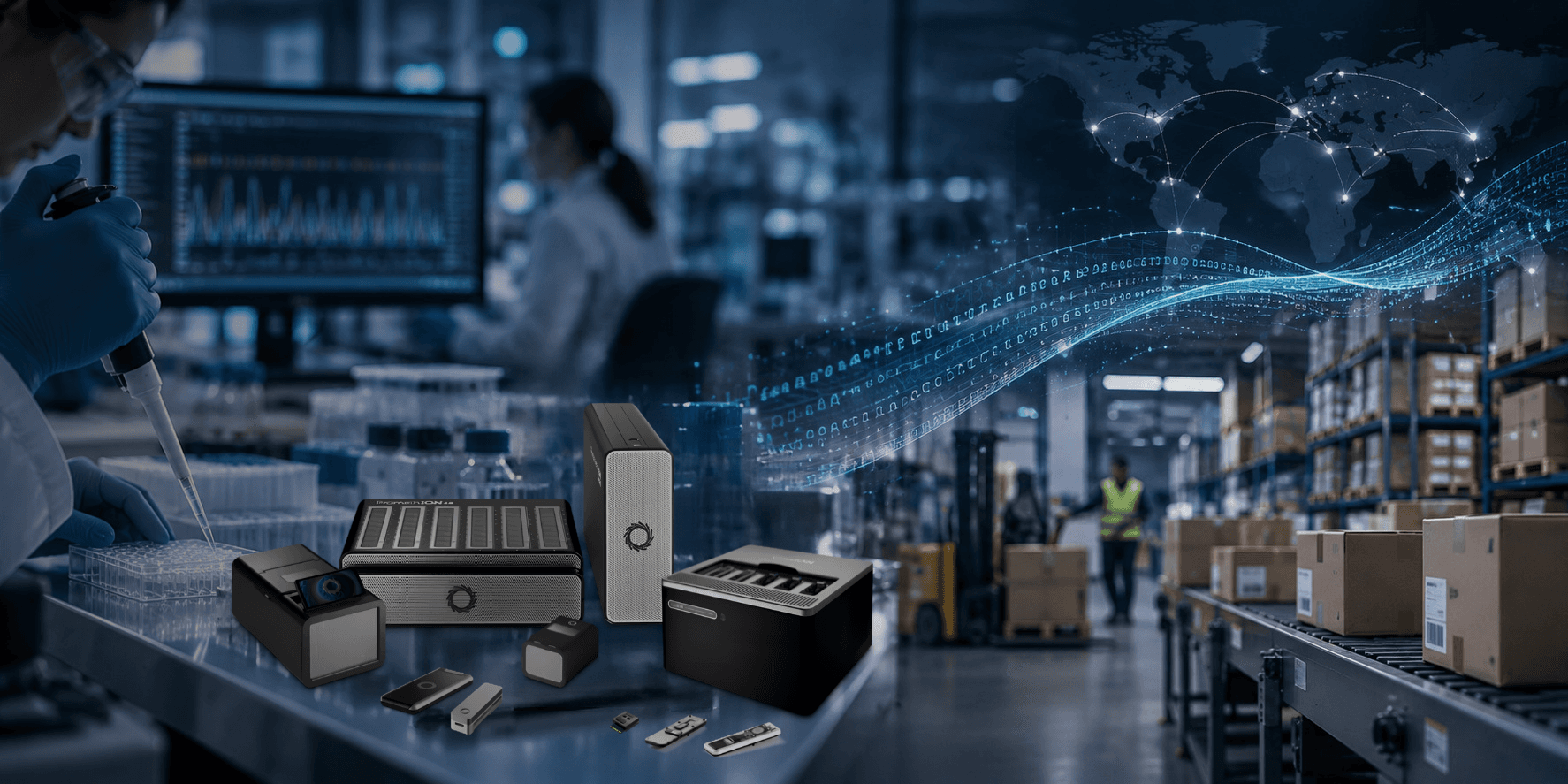
There are also examples in life sciences. STEMCELL Technologies has publicly discussed its demand-driven supply-chain transformation, while Oxford Nanopore Technologies has incorporated DDMRP into the supply chain supporting its sequencing technology portfolio.
Oxford Nanopore is particularly interesting. Its products bring together instruments, electronics, chemistry and biological consumables, while operating in a market where technology and customer requirements can change quickly.
We'll look at that implementation separately in DDMRP in Life Sciences: What Oxford Nanopore's Supply Chain Transformation Can Teach the Industry.
“Thoughtware before software”
For Titmuss, one of the biggest mistakes is starting with the technology.
His phrase is simple: “Thoughtware before software.”
Planning software can process enormous amounts of information, calculate buffers and help planners identify priorities. But the business first needs to understand its own supply chain: where variability causes problems, where inventory needs to sit and what is preventing products from flowing reliably.
Titmuss also recommends proving the approach before trying to transform everything. Start with an appropriate part of the business, understand its current performance and run a pilot. Then look at what actually changed. Did service improve? Did inventory fall? Did lead times change? Did the economics make sense?
For businesses carrying significant amounts of inventory while still dealing with shortages, late deliveries and constant expediting, DDMRP raises a useful question: is the problem really how much inventory you have, or how your supply chain has been designed to use it?
Sources & further reading
Miclo, R., Lauras, M., Fontanili, F., Lamothe, J. & Melnyk, S.A. — “Demand Driven MRP: assessment of a new approach to materials management.” International Journal of Production Research.
Read the research paperKortabarria, A., Apaolaza, U., Lizarralde, A. & Amorrortu, I. — “Material management without forecasting: From MRP to demand driven MRP.” Journal of Industrial Engineering and Management, 2018, 11(4), 632–650.
Read the peer-reviewed studyAzzamouri, A. et al. — “Demand Driven Material Requirements Planning (DDMRP): A systematic review and classification.” Journal of Industrial Engineering and Management, 2021.
Read the systematic reviewDemand Driven Institute — DDMRP case studies.
Demand Driven Institute case studiesCoca-Cola Beverages Africa — DDMRP implementation materials.
CCBA implementation announcementOregon Freeze Dry / OFD Foods — DDMRP case materials.
OFD Foods case studyPtak, C. & Smith, C. — Orlicky's Material Requirements Planning, 3rd edition, 2011.
Ptak, C. & Smith, C. — Demand Driven Material Requirements Planning (DDMRP), Industrial Press.
Ken Titmuss
· Webiste: https://www.kentoutserv.com/
· LinkedIn: https://www.linkedin.com/in/ken-titmuss-4408341/
· Youtube: https://youtube.com/@kentitmuss?si=6VULU2WgIvLLgsET